1. The Bottom Line (TL;DR)
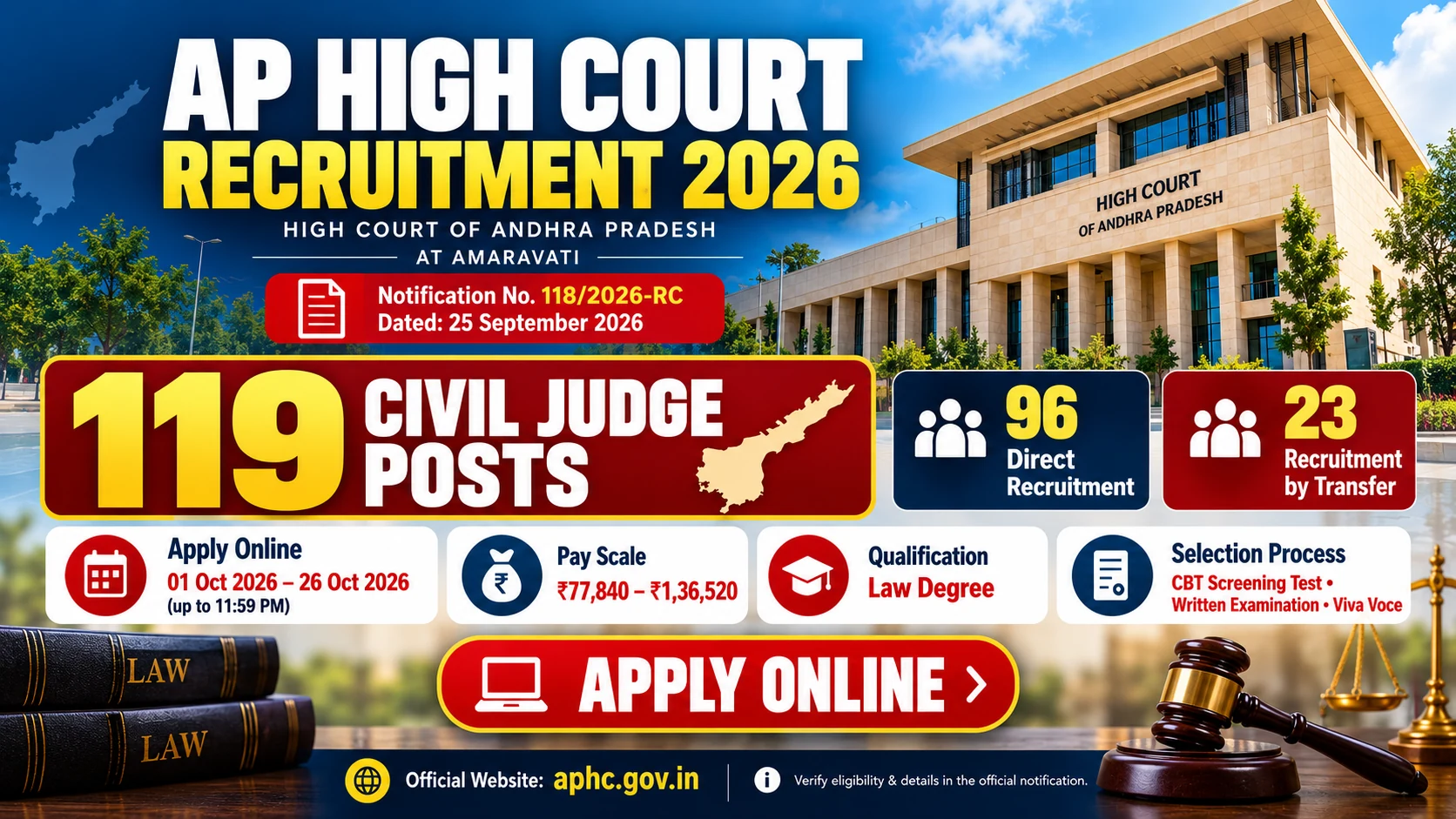
The High Court of Andhra Pradesh at Amaravati has issued official Notification No. 118/2026-RC dated 25 September 2026 for appointment to the posts of Civil Judge (Junior Division) in the Andhra Pradesh State Judicial Service. A total of 119 vacancies are notified, comprising 96 posts under Direct Recruitment and 23 posts under Recruitment by Transfer.
The cadre carries the revised National Judicial Pay Commission scale of Rs. 77,840 – 1,36,520. The online application registration window opens on 1 October 2026 and closes on 26 October 2026 at 11:59 PM. All registrations, hall ticket releases, and answer key notices are administered exclusively through the official portal at https://aphc.gov.in.
- Recruiting Body: High Court of Andhra Pradesh at Amaravati
- Cadre: Civil Judge (Junior Division) — Andhra Pradesh State Judicial Service
- Total Posts: 119 (96 Direct Recruitment + 23 Recruitment by Transfer)
- Pay Scale: Rs. 77,840 – 1,36,520
- Registration Dates: 1 October 2026 to 26 October 2026 (11:59 PM)
- Screening Test Mode: Computer Based Test (CBT) across 6 regional centers in Andhra Pradesh
- Official Notification & Portal: aphc.gov.in
2. Strict Eligibility & “Hidden Traps”
Judicial service rules enforce strict statutory eligibility conditions governed by the Andhra Pradesh State Judicial (Service & Cadre) Rules, 2026. Review these clauses carefully before filling the online form:
A. Educational Qualifications & The Supreme Court “Bhumika Trust” Ruling
- Direct Recruitment: Candidates must possess a regular Degree in Law from an established and recognised university in India.
- Fresh Law Graduates Trap Resolved: Historically, multi-year bar standing was contested. In this recruitment cycle, the High Court has explicitly incorporated the landmark Supreme Court of India judgment in Bhumika Trust Vs. Union of India and others (Writ Petition Civil No. 1110/2025, dated 21.08.2026). All law graduates who have obtained their Law Degree preceding one year as on the date of notification (25.09.2026) are fully eligible to compete for Civil Judge (Junior Division) posts for the year 2026.
- Recruitment by Transfer: Must hold a Degree in Law and be an approved probationer or confirmed member in eligible cadres within the High Court registry, District Judiciary, State Prosecution Service, Law Department, Legislature Secretariat, or the Advocate General’s Establishment.
B. Exact Age Bounds (Calculated as on 01.09.2026)
The official reference date for age determination is 1 September 2026 (the first day of the month in which the notification was published):
- Direct Recruitment (Open Category): Must not have completed 35 years of age as on 01.09.2026. Candidate must have been born on or after 02.09.1991.
- SC / ST / BC / EWS Categories: 5-year upper age relaxation applies. Maximum permissible age is 40 years as on 01.09.2026 (born on or after 02.09.1986).
- Persons with Benchmark Disabilities (PwBD): 10-year upper age relaxation applies. Maximum permissible age is 45 years as on 01.09.2026 (born on or after 02.09.1981).
- Defence Service Ex-Servicemen: Duration of military service rendered in the Indian Armed Forces is excluded from computing total age.
- Recruitment by Transfer: Must not have completed 48 years of age as on 01.09.2026 (born on or after 02.09.1978).
C. Local Certificate & Disqualification Traps
- BC Non-Creamy Layer Validity: Backward Class candidates (Groups A, B, C, D, E) must hold a Non-Creamy Layer certificate issued specifically in the calendar year 2025 or 2026 by an authorised Tahsildar. Older certificates lead to automatic re-classification into the Open Competition (OC) pool without fee concessions.
- EWS Income Limit: EWS certificates must be issued in 2025 or 2026 certifying a gross annual family income below Rs. 8,00,000/- in terms of G.O.Ms.No.66 and G.O.Ms.No.73.
- Marital Disqualifications: Bigamous relations strictly disqualify applicants. Any candidate having more than one spouse living, or marrying an individual who already has a living spouse, is statutorily ineligible.
- Character & Disciplinary Inquiry: Anyone dismissed or compulsorily retired from judicial service, or facing subsisting departmental penalties in government departments, cannot apply under Transfer quota.
3. Vacancy & Reservation Breakdown
The 119 vacancies are partitioned between Direct Recruitment (96 posts) and Recruitment by Transfer (23 posts), following the vertical roster rules and horizontal reservations for women and PwBD candidates.
Direct Recruitment Vacancies (96 Posts)
| Category / Class | Total Posts | Women Quota | Horizontal & Special Reservations |
|---|---|---|---|
| Open Competition (OC) | 39 | 13 | 1 Blindness/Low Vision, 1 Deaf/Hard Hearing, 1 Locomotor/Acid Attack/Dwarfism, 1 Autism/Mental Illness |
| Economically Weaker Section (EWS) | 9 | 3 | Vertical quota as per G.O.Ms.No.77 |
| Backward Class (Group-A) | 7 | 2 | Subject to 2025/2026 Non-Creamy Layer certificate |
| Backward Class (Group-B) | 10 | 3 | Subject to 2025/2026 Non-Creamy Layer certificate |
| Backward Class (Group-C) | 1 | 0 | Open category within BC-C |
| Backward Class (Group-D) | 6 | 2 | Subject to 2025/2026 Non-Creamy Layer certificate |
| Backward Class (Group-E) | 4 | 1 | Subject to Civil Appeal Nos. 2628-2637/2010 before Supreme Court |
| Scheduled Caste (Group-I) | 1 | 0 | Sub-categorisation quota |
| Scheduled Caste (Group-II) | 7 | 2 | Sub-categorisation quota |
| Scheduled Caste (Group-III) | 6 | 2 | Sub-categorisation quota |
| Scheduled Tribe (ST) | 6 | 2 | Roster quota |
| Total Direct Recruitment | 96 | 30 | 4 PwBD horizontal reservation posts |
Recruitment by Transfer Vacancies (23 Posts)
| Class / Category | Total Posts | Eligibility Scope |
|---|---|---|
| Open Competition (OC) | 18 | High Court registry, Subordinate Judiciary, Law Dept, AG Office |
| Scheduled Caste (Group-I) | 1 | Confirmed in service / approved probationer |
| Scheduled Caste (Group-III) | 1 | Confirmed in service / approved probationer |
| Scheduled Tribe (ST) | 3 | Confirmed in service / approved probationer |
| Total Transfer Quota | 23 | Open to approved departmental probationers with Law degree |
4. Step-by-Step Portal Walkthrough
All candidates must submit their application online through the official portal of the High Court of Andhra Pradesh at aphc.gov.in. Offline physical submissions are not accepted.
Phase 1: Portal Navigation & Registration
- Navigate to the High Court of Andhra Pradesh portal at
https://aphc.gov.in. - Locate the Recruitment section and select Notification No. 118/2026-RC — Civil Judge (Junior Division).
- Click on New Registration to initiate the application profile.
- Input your Full Legal Name (matching Class 10 / SSC records), active Mobile Number, and Personal Email Address.
- Complete the OTP verification sent to your registered mobile number and email. Save the system-generated Registration ID and Login Credentials.
Phase 2: Form Entry & Center Preference
- Log in using your Registration Number and Password.
- Select your application stream: Direct Recruitment or Recruitment by Transfer.
- Fill personal credentials, communication address, permanent domicile details, and marital declarations.
- Fill academic details: SSC/Class 10, Intermediate/10+2, Graduation, and Law Degree (3-Year or 5-Year Integrated Course), along with university registration details.
- Select three examination city preferences in order of choice from the available 6 centers:
- Guntur
- Kurnool
- Rajahmundry (Rajamahendravaram)
- Tirupati
- Vijayawada
- Visakhapatnam
Phase 3: Document Upload Specifications
Prepare all scanned digital files in advance according to official dimensions:
- Recent Color Passport Photograph: 3.5 cm x 4.5 cm, clear white background, JPEG format (20 KB to 50 KB).
- Candidate Signature: Black ink on white paper, JPEG format (10 KB to 30 KB).
- SSC / Date of Birth Certificate: PDF format (100 KB to 300 KB).
- Law Degree Certificate / Provisional Pass Certificate: PDF format (100 KB to 500 KB).
- Community Certificate (SC/ST/BC/EWS): Issued by competent revenue authorities (PDF, 100 KB to 300 KB).
- Non-Creamy Layer Certificate (BC Applicants): Dated within calendar years 2025 or 2026 (PDF, 100 KB to 300 KB).
- Medical Disability Certificate (PwBD): Issued by designated District Medical Board (PDF, 100 KB to 300 KB).
- For Transfer Applicants: Employer permission for law degree, service-cum-conduct certificate, and probation declaration orders.
Phase 4: Fee Payment & Final Printout
- Review the preview summary page. Verify every spelling, degree roll number, and category selection. Once submitted, editing is locked.
- Proceed to the payment gateway:
- OC / EWS / BC Applicants: ₹1,500
- SC / ST (Andhra Pradesh) / PwBD: ₹750
- Complete the transaction via Net Banking, Debit Card, Credit Card, or UPI.
- Download the generated e-Receipt and complete submitted Application Form. Retain multiple physical copies for Document Verification.
5. Application Mistakes That Cause Rejection
Judicial recruitment scrutiny is unforgiving. These three critical document verification errors routinely lead to outright disqualification:
- Submitting Outdated Non-Creamy Layer or EWS Certificates: Clause IV(3) and IV(4) of the notification mandate that BC Non-Creamy Layer and EWS certificates must be issued in calendar year 2025 or 2026. Uploading certificates from 2024 or earlier results in summary forfeiture of reservation benefits, moving the candidate to the unreserved OC list where fee concessions and relaxed qualifying cut-offs do not apply.
- Discrepancy in Name or Date of Birth Across SSC and Law Certificates: The High Court takes strict notice of surname initials or spelling mismatches between Class 10 certificates, Bar Council enrollment (if applicable), and degree records. Any discrepancy must be supported by an official gazette notification or sworn affidavit at the time of online entry.
- Omitting Departmental NOC or Conduct Certificate (Transfer Quota): In-service candidates applying under Recruitment by Transfer must upload proof of declaration of probation, permission to pursue law studies while in service, and a recent Service and Conduct Certificate. Applying without explicit departmental sanction or facing pending disciplinary inquiries causes immediate rejection without notice.
6. Selection Process & Exam Pattern
The selection process comprises three progressive stages: a Computer Based Screening Test, a 3-Paper Written Examination, and Viva Voce.
Screening Test (100 Marks, CBT) → Written Exam (3 Papers, 300 Marks) → Viva Voce (50 Marks) → 2-Year Trainee Judicial Officer PeriodStage 1: Computer Based Screening Test (Objective)
- Question Type: 100 Multiple Choice Questions (Objective)
- Total Marks: 100 marks
- Duration: 2 hours (120 minutes)
- Qualifying Criterion: Minimum 40% marks to be eligible for shortlisting.
- Shortlisting Ratio: Candidates are shortlisted in the ratio of 1:10 of notified vacancies in respective categories for the Written Examination.
- Merit Status: Screening marks are qualifying only and are not added to the final merit score.
Stage 2: Written Examination (Descriptive)
The written exam consists of three papers of 100 marks each, 3 hours duration each. All answers must be written in English (except Translation in Paper-III).
| Paper | Subject / Content | Total Marks | Duration | Language | Weightage in Final Merit |
|---|---|---|---|---|---|
| Paper-I | Civil Laws | 100 | 3 Hours | English | Counted for Selection |
| Paper-II | Criminal Laws | 100 | 3 Hours | English | Counted for Selection |
| Paper-III | English (Translation & Legal Essay) • Part-I: Translation English ↔ Telugu (40 Marks) • Part-II: Essay on Legal Subjects (60 Marks) |
100 | 3 Hours | English & Telugu | Qualifying Only (Min 40% in Part-I & 40% in Part-II; marks not counted for viva or merit) |
Minimum Qualifying Marks in Written Exam to Qualify for Viva Voce
| Recruitment Category | Minimum Marks in Paper-I & Paper-II | Minimum Aggregate in Written Exam |
|---|---|---|
| Open Competition (OC) & EWS | 55% in each paper | 60% Aggregate |
| Backward Classes (BC) | 50% in each paper | 55% Aggregate |
| SC / ST / PwBD | 45% in each paper | 50% Aggregate |
| Recruitment by Transfer | 55% in each paper | 60% Aggregate |
Stage 3: Viva Voce & Final Selection
- Marks: 50 marks. Shortlisting ratio for Viva Voce is 1:3 of available vacancies.
- Final Merit Calculation: Sum of marks obtained in Paper-I (Civil Laws) + Paper-II (Criminal Laws) + Viva Voce. (Total = 250 Marks).
- Minimum Combined Qualifying Benchmark:
- OC & EWS: Minimum 60% aggregate
- BC: Minimum 55% aggregate
- SC / ST / PwBD: Minimum 50% aggregate
- Transfer: Minimum 60% aggregate
- Tie-Breaking Rule: Elder candidate by date of birth takes precedence; if birth dates are identical, higher marks in law degree govern selection.
Comprehensive Syllabus
Civil Laws (Paper-I)
- Code of Civil Procedure, 1908
- Indian Contract Act, 1872
- Hindu Marriage Act, 1955
- Hindu Succession Act, 1956
- Indian Easements Act, 1882
- Specific Relief Act, 1963
- Limitation Act, 1963
- Transfer of Property Act, 1882
- Civil Rules of Practice
- Registration Act, 1908 & Indian Stamp Act, 1899
- Andhra Pradesh Land Encroachment Act, 1905
- Indian Evidence Act, 1872
- Bharatiya Sakshya Adhiniyam, 2023 (BSA)
Criminal Laws (Paper-II)
- Code of Criminal Procedure, 1973
- Indian Evidence Act, 1872
- Indian Penal Code, 1860
- Bharatiya Nagarik Suraksha Sanhita, 2023 (BNSS)
- Bharatiya Sakshya Adhiniyam, 2023 (BSA)
- Bharatiya Nyaya Sanhita, 2023 (BNS)
- Negotiable Instruments Act, 1881
- Protection of Women from Domestic Violence Act, 2005
- Criminal Rules of Practice
- Andhra Pradesh Excise Act, 1968
- Andhra Pradesh Gaming Act, 1974
- Juvenile Justice (Care and Protection of Children) Act, 2015
- Food Safety and Standards Act, 2006
- Information Technology Act, 2000
- Protection of Children from Sexual Offences (POCSO) Act, 2012
- Andhra Pradesh Forest Act, 1967
Post-Selection Training & Law Clerkship
Selected candidates are designated as Trainee Judicial Officers and undergo a two-year foundation phase:
- Year 1: Intensive residential training at the Andhra Pradesh Judicial Academy (stipend: 50% of Civil Judge pay).
- Year 2: Structured Law Clerkship comprising 6 months under a Principal District & Sessions Judge and 6 months under a Judge of the High Court of Andhra Pradesh. Upon submission of a satisfactory evaluation report, candidates are confirmed into the regular cadre on the full pay scale of Rs. 77,840 – 1,36,520.