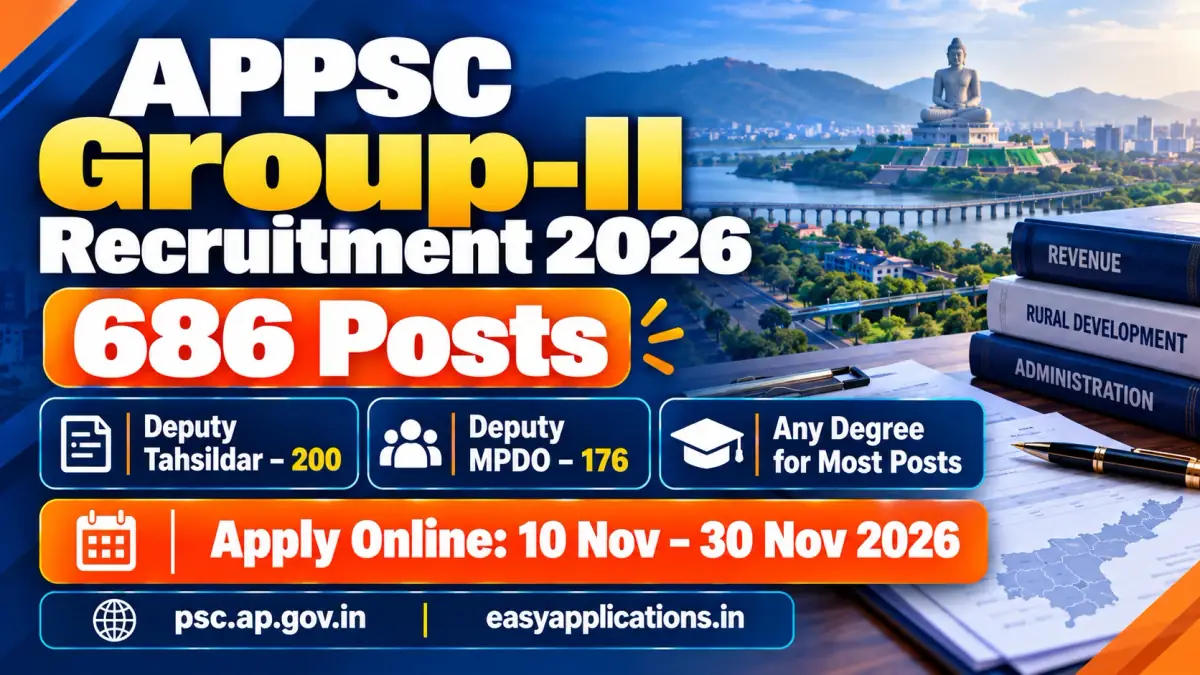
The Andhra Pradesh Public Service Commission (APPSC) has issued a brief notification for 686 Group-II posts across 12 categories. The largest are Deputy Tahsildar (200) and Deputy Mandal Parishad Development Officer (176). Online applications run from 10 to 30 November 2026. Selection is through an offline Screening Test, followed by a Main exam of two objective papers.
Who can apply: graduates; some posts need a specific degree or a computer qualification (see eligibility) · Age limit and its reckoning date: in the detailed notification, due by 10 Nov 2026 · Qualification must be held on the detailed notification date · Apply 10–30 Nov 2026, 11:59 PM
Written from APPSC Brief Notification No. 37/2026 dated 13/10/2026 on 14 October 2026.
On this page: Dates · Posts and pay · Eligibility · Exam pattern · Computer Proficiency Test · Full syllabus · Points to check · How to apply
APPSC Group-II 2026: important dates
| Event | Date |
|---|---|
| Brief notification | 13 October 2026 |
| Detailed notification on psc.ap.gov.in | On or before 10 November 2026 |
| Online applications | 10 to 30 November 2026, 11:59 PM |
| Screening Test | Date in the detailed notification |
The date of the detailed notification is the crucial date “in all aspects”, so APPSC will judge your eligibility as on that date.
APPSC Group-II 2026: posts and pay scale
| No. | Post | Vacancies | Scale of pay (Rs) |
|---|---|---|---|
| 01 | Municipal Commissioner Grade-III | 6 | 45,830–1,30,580 |
| 02 | Sub-Registrar Grade-II (Registrations and Stamps) | 7 | 44,570–1,27,480 |
| 03 | Deputy Tahsildar (A.P. Revenue Service) | 200 | 44,570–1,27,480 |
| 04 | Goods and Service Tax Officer (erstwhile ACTO), Commercial Tax | 40 | 45,830–1,30,580 |
| 05 | Assistant Registrar of Cooperative Societies | 10 | 45,830–1,30,580 |
| 06 | Deputy Mandal Parishad Development Officer (PR & RD) | 176 | 45,830–1,30,580 |
| 07 | Prohibition and Excise Sub-Inspector | 29 | 40,970–1,24,380 |
| 08 | Assistant Section Officer (GAD), A.P. Secretariat | 71 | 40,970–1,24,380 |
| 09 | Assistant Section Officer (Finance Dept.), A.P. Secretariat | 5 | 40,970–1,24,380 |
| 10 | Assistant Section Officer (Law Dept.), A.P. Secretariat | 4 | 40,970–1,24,380 |
| 11 | Senior Accountant, Treasuries and Accounts (HOD) | 90 | 34,580–1,07,210 |
| 12 | Junior Accountant, Treasuries and Accounts (HODs) | 48 | 25,220–80,910 |
| Total | 686 |
The 12 rows add up to the 686 stated in the notice. The vacancies are provisional and can change when departments confirm them. The pay figures are scales of pay, the range basic pay moves through; your in-hand salary will be higher once allowances are added. Category-wise and zone-wise breakups will come with the detailed notification.
Eligibility: qualification by post
| Posts | Qualification |
|---|---|
| 01 to 08 (Municipal Commissioner to ASO GAD) | A bachelor’s degree from a recognised university, or equivalent |
| 02 Sub-Registrar (preference) | Candidates who also hold a law degree get preference |
| 09 ASO (Finance) | Bachelor’s degree in Mathematics, Economics or Commerce |
| 10 ASO (Law) | Bachelor’s degree in Law |
| 11 and 12 Senior and Junior Accountant | A degree (see below) and a computer qualification |
Senior and Junior Accountant: the rule names a degree in Commerce, Economics or Mathematics, but a proviso makes any degree from a recognised university eligible. On top of the degree you need one of these:
- a pass in an SBTET (Board of Technical Education and Training, A.P.) certificate course in Office Automation, PC Maintenance and Trouble Shooting or Web Designing; or
- a degree in BCA, B.Sc. (Computers), B.Com. (Computers), B.A. (Computers), or B.Tech/B.E. in Computer Science or IT, or equivalent.
Prohibition and Excise Sub-Inspector: physical requirements apply. APPSC will list them in the detailed notification.
Final-year and result-awaited students: you must already hold the qualification on the date of the detailed notification. A degree completed after that date does not count.
APPSC Group-II 2026 exam pattern
Both stages are objective, degree standard, and both carry negative marking of one-third of the marks for each wrong answer. The Screening Test is offline, on OMR sheets.
| Stage | Paper | Questions | Time | Marks |
|---|---|---|---|---|
| Screening Test | General Studies and Mental Ability | 150 | 150 min | 150 |
| Main exam | Paper I: Social and Cultural History of AP; Indian Constitution | 150 | 150 min | 150 |
| Main exam | Paper II: Indian and AP Economy; Science and Technology | 150 | 150 min | 150 |
The Main exam totals 300 marks. The brief notification does not say how many candidates are shortlisted from the Screening Test, or whether its marks count towards the final merit. The detailed notification should settle both.
Computer Proficiency Test (CPT)
The notice annexes a CPT scheme: a 60-minute practical test for 100 marks on office automation.
| Category | Minimum qualifying marks |
|---|---|
| SC, ST, PBD | 30 |
| BC | 35 |
| OC | 40 |
| Part | What it tests | Weight |
|---|---|---|
| A | Multiple-choice questions | 20% |
| B | Typing speed | 25% |
| B | Formatted document with tables, images and mail merge; inserting objects | 15% |
| B | Excel sheet with formulas, conditional formatting and charts | 20% |
| B | PowerPoint presentation with layouts, images, transitions and animation | 20% |
The software can be MS Office or an open-source suite such as LibreOffice. The notice says the typing-speed component “may be made mandatory for qualifying”.
APPSC Group-II 2026 syllabus
This is the full syllabus from the notification’s annexure. Each paper is collapsed; tap a heading to open it. The marks for each section are as given by APPSC.
Screening Test: General Studies and Mental Ability (150 marks)
Indian History (30 marks)
- Ancient History: salient features of the Indus Valley Civilization and the Vedic age; emergence of Buddhism and Jainism; the Mauryan and Gupta Empires: their administration, socio-economic and religious conditions, art and architecture, literature; Harshavardhana and his achievements.
- Medieval History: the Chola administrative system; the Delhi Sultanate and the Mughal Empire: their administration, socio-economic and religious conditions, art and architecture, language and literature; Bhakti and Sufi movements; Shivaji and the rise of the Maratha Empire; advent of the Europeans.
- Modern History: the 1857 Revolt and its impact; rise and consolidation of British power in India; changes in administration, social and cultural spheres; social and religious reform movements in the 19th and 20th centuries; the Indian National Movement: its various stages and important contributors and contributions from different parts of the country; post-Independence consolidation and reorganization within the country.
Geography (30 marks)
- General and Physical Geography: the Earth in our Solar System; interior of the Earth; major landforms and their features; climate: structure and composition of the atmosphere; ocean water: tides, waves, currents; India and Andhra Pradesh: major physiographic features, climate, drainage system, soils and vegetation; natural hazards and disasters and their management.
- Economic Geography of India and AP: natural resources and their distribution; agriculture and agro-based activities; distribution of major industries and major industrial regions; transport, communication, tourism and trade.
- Human Geography of India and AP: human development; demographics; urbanization and migration; racial, tribal, religious and linguistic groups.
Indian Society (30 marks)
- Structure of Indian Society: family, marriage, kinship, caste, tribe, ethnicity, religion and women.
- Social Issues: casteism, communalism and regionalisation; crime against women; child abuse and child labour; youth unrest and agitation.
- Welfare Mechanism: public policies and welfare programmes; constitutional and statutory provisions for Scheduled Castes, Scheduled Tribes, minorities, BCs, women, the disabled and children.
Current Affairs (30 marks)
- Major current events and issues pertaining to: International, National, and the State of Andhra Pradesh.
Mental Ability (30 marks)
- Logical Reasoning (deductive, inductive, abductive): statement and assumptions, statement and argument, statement and conclusion, statement and courses of action.
- Mental Ability: number series, letter series, odd man out, coding-decoding, problems relating to relations, shapes and their sub-sections.
- Basic Numeracy: number system, order of magnitude, averages, ratio and proportion, percentage, simple and compound interest, time and work, time and distance; data analysis (tables, bar diagram, line graph, pie chart).
Main Paper I, Section A: Social and Cultural History of Andhra Pradesh (75 marks)
- Pre-historic cultures; the Satavahanas, the Ikshvakus: socio-economic and religious conditions, literature, art and architecture; the Vishnukundins, the Eastern Chalukyas of Vengi, the Andhra Cholas: society, religion, Telugu language, art and architecture.
- Various major and minor dynasties that ruled Andhradesa between the 11th and 16th centuries A.D.: socio-religious and economic conditions, growth of Telugu language and literature, art and architecture in Andhradesa between the 11th and 16th centuries A.D.
- Advent of the Europeans; trade centres; Andhra under the Company; the 1857 Revolt and its impact on Andhra; establishment of British rule; socio-cultural awakening, the Justice Party/Self Respect Movement; growth of the Nationalist Movement in Andhra between 1885 and 1947; role of Socialists and Communists; Anti-Zamindari and Kisan movements; growth of nationalist poetry, revolutionary literature, Nataka Samasthalu and women’s participation.
- Origin and growth of the Andhra Movement; role of the Andhra Mahasabhas; prominent leaders; events leading to the formation of Andhra State, 1953; role of the press and newspapers in the Andhra Movement; role of the Library Movement and folk and tribal culture.
- Events leading to the formation of Andhra Pradesh State; the Visalandhra Mahasabha; the States Reorganization Commission and its recommendations; the Gentlemen’s Agreement; important social and cultural events between 1956 and 2014.
Main Paper I, Section B: Indian Constitution (75 marks)
- Nature of the Indian Constitution; constitutional development; salient features of the Indian Constitution; the Preamble; Fundamental Rights, Directive Principles of State Policy and their relationship; Fundamental Duties; amendment of the Constitution; Basic Structure of the Constitution.
- Structure and functions of the Indian Government: Legislature, Executive and Judiciary; types of legislatures: unicameral, bicameral; Executive: parliamentary; Judiciary: judicial review, judicial activism.
- Distribution of legislative and executive powers between the Union and the States; legislative, administrative and financial relations between the Union and the States; powers and functions of constitutional bodies; Human Rights Commission; RTI; Lokpal and Lok Ayukta.
- Centre-State relations: need for reforms; Rajmannar Committee, Sarkaria Commission, M.M. Punchchi Commission; unitary and federal features of the Indian Constitution; Indian political parties; party system in India; recognition of national and state parties; elections and electoral reforms; Anti-Defection Law.
- Centralization vs decentralization; Community Development Programme; Balwant Rai Mehta and Ashok Mehta Committees; the 73rd and 74th Constitutional Amendment Acts and their implementation.
Main Paper II, Section A: Indian and AP Economy (75 marks)
- Structure of Indian Economy, Economic Planning and Policy: National Income of India: concept and measurement; occupational pattern and sectoral distribution of income in India; economic growth and economic development; strategy of planning in India; New Economic Reforms 1991; decentralization of financial resources; NITI Aayog.
- Money, Banking, Public Finance and Foreign Trade: functions and measures of money supply; Reserve Bank of India (RBI): functions, monetary policy and control of credit; Indian banking: structure, development and reforms; inflation: causes and remedies; India’s fiscal policy: fiscal imbalance, deficit finance and fiscal responsibility; Indian tax structure; Goods and Services Tax (GST); recent Indian Budget; India’s Balance of Payments (BOP); FDI.
- Agricultural Sector, Industrial Sector and Services in Indian Economy: Indian agriculture: cropping pattern, agricultural production and productivity; agricultural finance and marketing in India: issues and initiatives; agricultural pricing and policy in India: MSP, procurement, issue price and distribution; industrial development in India: patterns and problems; New Industrial Policy, 1991; disinvestment; Ease of Doing Business; industrial sickness: causes, consequences and remedial measures; services sector: growth and contribution of the services sector in India; role of the IT and ITES industry in development.
- Structure of Andhra Pradesh Economy and Public Finance: structure and growth of the AP economy: Gross State Domestic Product (GSDP) and sectoral contribution, AP Per Capita Income (PCI); AP State revenue: tax and non-tax revenue; AP State expenditure, debts and interest payments; Central assistance; projects of external assistance; recent AP Budget.
- Agriculture and Allied Sector, Industrial Sector and Services Sector of Andhra Pradesh: production trends of agriculture and allied sectors; cropping pattern; rural credit cooperatives; agricultural marketing; strategies, schemes and programmes related to the agricultural and allied sectors in Andhra Pradesh, including horticulture, animal husbandry, fisheries and forests; growth and structure of industries; recent AP Industrial Development Policy; Single Window Mechanism; industrial incentives; MSMEs; industrial corridors; structure and growth of the services sector; Information Technology, Electronics and Communications in Andhra Pradesh; recent AP IT Policy.
Main Paper II, Section B: Science and Technology (75 marks)
- Technology Missions, Policies and Applications: National S&T Policy: recent Science, Technology and Innovation Policy, and national strategies and missions, emerging technology frontiers; Space Technology: launch vehicles of India, recent Indian satellite launches and their applications, Indian space science missions; Defence Technology: Defence Research and Development Organisation (DRDO): structure, vision and mission, technologies developed by DRDO, Integrated Guided Missile Development Programme (IGMDP); Information and Communication Technology (ICT): National Policy on Information Technology; Digital India Mission: initiatives and impact; e-Governance programmes and services; cyber security concerns; National Cyber Security Policy; Nuclear Technology: Indian nuclear reactors and nuclear power plants, applications of radioisotopes, India’s nuclear programme.
- Energy Management: policy and projections: installed energy capacities and demand in India; National Energy Policy; National Policy on Biofuels; Bharat Stage norms; non-renewable and renewable energy: sources and installed capacities in India; new initiatives and recent programmes, schemes and achievements in India’s renewable energy sector.
- Ecosystem and Biodiversity: ecology and ecosystem: basic concepts of ecology, ecosystem components and types; biodiversity: meaning, components, biodiversity hotspots, loss of biodiversity and conservation of biodiversity: methods, recent plans, targets, conventions and protocols; wildlife conservation: CITES and endangered species with reference to India; biosphere reserves; Indian wildlife conservation efforts, projects, acts and initiatives in recent times.
- Waste Management and Pollution Control: solid waste: solid wastes and their classification; methods of disposal and management of solid wastes in India; environmental pollution: types, sources and impacts; pollution control, regulation and alternatives: recent projects, acts and initiatives to reduce environmental pollution in India; impact of transgenics on the environment and their regulation; eco-friendly technologies in agriculture; bioremediation: types and scope in India.
- Environment and Health: environment challenges: global warming, climate change, acid rain, ozone layer depletion, ocean acidification; environmental initiatives: recent international initiatives, protocols and conventions to tackle climate change, with special reference to India’s participation and role; sustainable development: meaning, nature, scope, components and goals; health issues: recent trends in disease burden and epidemic and pandemic challenges in India; preparedness and response: healthcare delivery and outcomes in India; recent public health initiatives and programmes.
Computer Proficiency Test (CPT) syllabus
Part A
- Introduction to Computers: components and their classification; peripheral devices and their purpose. Input devices: keyboard, mouse, scanner, “Lighten” (as printed; probably light pen), touch screens, joystick, microphone, digital camera, bar code reader, biometric sensor. Output devices: display devices, printers, monitor, speaker, plotter. Secondary storage devices: “Feature-Driven Development (FDD)” (as printed; see the note below), magnetic tape, Universal Serial Bus (USB), pen drives, disks. The role of input, processing and output devices; computing concepts: data, information, Random Access Memory (RAM), Read-Only Memory (ROM), control unit, memory unit, Arithmetic Logic Unit (ALU).
- Computer Software Types: system software, application software, embedded software, proprietary software, open source software (their purpose and characteristics only).
- Operating System: purpose of an operating system; single-user and multi-user operating systems with examples.
- Windows Operating System: Graphical User Interface (GUI); differences between Character User Interface (CUI) and GUI; working with files and folders; more about files; running an application through the File Manager and through the Program Manager; setting up a printer, webcam, scanner and other peripheral devices.
- Linux/Mac OS (basic concepts only): introduction to Linux; features and advantages of Linux; file handling and directory handling commands; user management; file permissions; Macintosh (Mac) OS: introduction, advantages, basic commands.
- Internet Concepts (basic concepts only): minimum hardware and software requirements for a system to use the internet; communication protocols and facilities; various browsers; what an Internet Protocol (IP) address is; steps to connect a system to a network; uploading and downloading files.
- Electronic Mail (basic concepts only): sending and receiving mail; basic e-mail functions; using your word processor for e-mail; finding e-mail addresses; mailing lists and list servers.
- World Wide Web (basic concepts only): advantages of the Web; how to navigate the Web; web searching.
Part B (MS Office, or an open-source suite such as LibreOffice, Apache OpenOffice or NeoOffice, on Windows, Linux or Mac OS)
- Office Suite and Getting Started: introduction to office software; starting and exiting office applications; the Office Shortcut Bar and customising it.
- File Operations: common office tools and techniques; opening an application; creating, entering and editing text; saving, opening and closing files; exiting the application; managing your files.
- Tools in Office Applications: key combinations; cut, copy and paste; drag-and-drop editing; menu bars and toolbars; undo and redo; spell checking; AutoCorrect; find and replace; help and the Office Assistant; templates and wizards.
- Word Processing (MS Word or equivalent): the Word window (title, menu, format and standard bars, ruler, workspace, scroll and status bars, toolbars); creating new and opening existing documents; typing, selecting, deleting, formatting, copying and moving text; saving; page setup; document properties; print preview and printing; select all, find, replace and go to; Normal, Web Layout, Print Layout and Outline views; document map; full screen; zoom; objects; page breaks; header and footer; page numbers; AutoFormat; AutoText; inserting date and time; footnotes, fields, symbols, captions, cross-references, index, tabs; tables and sorting; inserting and modifying pictures; WordArt; inserting charts and files; hyperlinks; bookmarks; fonts, paragraphs, bullets, borders and shading, columns, drop cap, themes, change case, background, frames and styles; spelling and grammar; set language; word count; AutoSummarize; merging and protecting documents; envelopes and labels; templates, wizards and sample documents; drawing tables, merging and splitting cells and tables, table AutoFormat, AutoFit, sort and formula; arrange all and split; Word Help; macros; custom toolbars, keyboard shortcuts and menus; mail merge.
- Spreadsheet (MS Excel or equivalent): features of Excel; the worksheet; selecting cells; navigating with mouse and keyboard; entering and editing text; text boxes and notes; spell check; undo and repeat; entering and editing formulas; cell references; order of evaluation in formulas; copying entries and equations; AutoFill and custom fill lists; protecting and unprotecting documents and cells; creating a new worksheet; formatting tips; moving, copying, sorting, inserting (including inserting as you paste), deleting and clearing cells; page setup; column widths and row heights; AutoFormat, manual formatting and styles; number format codes; Format Painter; font size and attributes; alignment and centring text across columns; borders, colour and shading; page breaks; hiding rows and columns; rearranging worksheets; Excel functions, parts of a function, functions requiring add-ins, the Function Wizard and examples by category; inserting rows and columns; saving and printing worksheets and large projects; organising data; charts: parts and terminology, the Chart Wizard, charts on separate sheets, resizing, moving, notes and arrows, editing, rotating 3-D charts, printing, deleting and setting the default chart type; trend lines; data maps; working with graphics in Excel: creating and placing graphic objects, resizing graphs, possible sources of Excel graphics; creating and running macros; sorting data; subtotals; customising Excel and the workspace; the Comma Separated Value (CSV) format; using worksheets as databases.
- Presentation Software (MS PowerPoint or equivalent): starting the software; views; slides and terminology; colour schemes; formatting slides; creating a presentation with the AutoContent Wizard, a template or a blank presentation; masters; working with, adding, editing, checking, finding, replacing, formatting and aligning text; working in Outline view; importing images and the Clip Art Gallery; drawing; inserting objects and pictures; working with graphics; multimedia; animating objects, pictures and graphics; slide show enhancements and showing slides out of order; developing your presentation and bringing it to life; printing presentation elements; finalising; transitions and timings; the master slide; setting up and running the slide show.
About the text:
- We have kept every topic in APPSC’s annexure. For easier reading, we changed only the punctuation and capitalisation, and grouped the long Word, Excel and PowerPoint lists by theme.
- We fixed obvious spelling slips, such as “Sate” for “State”, “Spilt” for “Split”, “Cantering” for “Centering”, “Order Of Evolution” for “Order of Evaluation” and “Pacing” for “Placing”.
- Two items in the CPT Part A list look like misprints, so we have kept APPSC’s wording in quotes:
- “Lighten”, which probably means light pen.
- “Feature-Driven Development (FDD)”, listed under secondary storage devices. FDD there most likely means Floppy Disk Drive, but check the detailed notification.
If anything here differs from the official notification, the official text is final.
Points to check in the detailed notification
- Age limit, fee and community-wise vacancies are not in the brief notification.
- Which posts need the CPT. The scheme is annexed, but the notice does not say which posts it applies to.
- Missing paragraph 4. The notice jumps from paragraph 3 (qualification) to paragraph 5 (physical requirements). Check whether the detailed notification adds anything that paragraph 4 should have covered.
- Senior and Junior Accountant qualification. We read the computer requirement as applying to every degree holder, because the “AND” comes after the any-degree proviso. Confirm this wording in the detailed notification.
How to apply for APPSC Group-II 2026
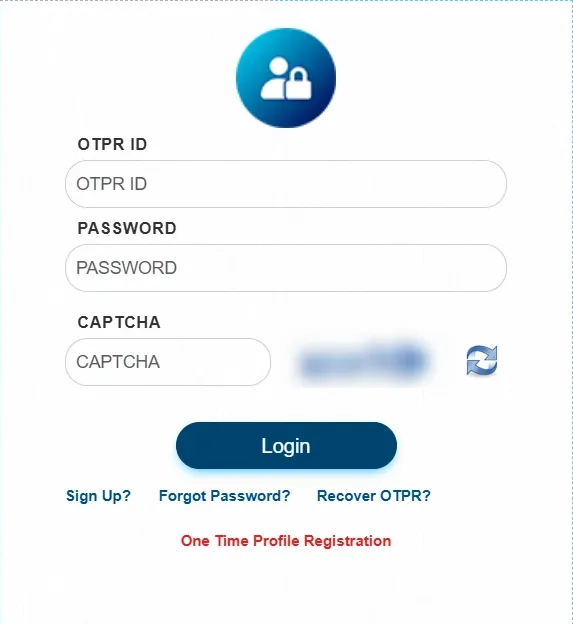
APPSC’s candidate login page (emblem header cropped and CAPTCHA blurred by us).
- Read the detailed notification on psc.ap.gov.in when it is published, on or before 10 November 2026.
- Keep your OTPR ID and password ready. APPSC’s candidate login asks for your OTPR ID, password and a CAPTCHA.
- If you have never registered, use the One Time Profile Registration link on the login page.
- If you have lost your ID, use Recover OTPR?.
- If you have lost your password, use Forgot Password?.
- Update your OTPR profile before the window opens, so that your details are current when you apply.
- Apply online only, between 10 and 30 November 2026. APPSC does not accept applications in any other mode. The detailed notification will give the step-by-step application process.
- Apply early; APPSC advises against waiting for the last-date rush.
If you are also preparing for Group-I, see our APPSC Group-I 2026 page. Both Screening Tests are objective and offline.
Official links: Brief Notification 37/2026 (PDF) · APPSC website